Showing posts with label 58. Show all posts

Tuesday, 24 March 2009

The key to MOUT: Speed not Haste

Fallujah copy

Maj Gen Richard Natonski briefing Task Force 2-2 prior to Operation Al-Fajr of the Second Battle of Fallujah

Military Operations in Urbanised Terrain (MOUT) is defined by US DOD as all operations planned and conducted across the range of military operations on or against objectives within, a topographical complex and its adjacent natural terrain where man-made construction or the density of non-combatants are the dominant feature. These operations are conducted to defeat an enemy that is almost always mixed in with civilians. Therefore, the rules of engagement (ROE) and use of combat force are heavily restrictive than in other conditions of combat.

As briefed earlier, in spite of a great build up of force, MOUT is always a very difficult sort of operation to achieve success in. Urban warfare is still the most vicious form of warfare. It takes the soldier back to the most primitive type of warfare demanding great tenacity, great precision, great courage and above all to conduct operations with little support fire in the most dangerous of situations. Therefore battle planners must be absolutely clear on why they are getting locked into this particularly risky type of operation and how the target fits to the overall battleplan. The risks involved with MOUT was also well versed by Sun Tszu in 500BC when he said that the worst policy (operation) was to attack cities.

Before the second World War most of the main theatres of battle were fought in open fields where the belligerents were lined up in formation. Because of this, fighting in cities or built up areas did not receive much attention until battles broke out in major cities like STALINGRAD or BERLIN towards the middle/end of World War II hence not until 1944 soldiers saw the first doctrines and guidance on how MOUT was conducted. But still soldiers came unstuck and found themselves in unfavourable terrain particularly in HUE during the 1968 TET offensive where the Marines had great experience in jungle but not in urban terrain. Hence it was not until 1979 after the Vietnam war the US Army published a separate Field Manual (90-10) for such operations; Military Operations in Urban Terrain.

With the continuous urbanisation of territory with increasing population and particularly due to 4th Generation warfare it is inevitable that any modern armed force will not encounter confrontations in urbanised terrain one way or another. I have chosen the Battle of FALLUJAH of 2004 because it is considered to be a turning point in modern military evolution due to the new technologies and tactics of the information era and the involvement of 4th Generation Warfare (4GW) characterised by a stateless entity fighting a state.

FALLUJAH located some 40 miles West of Baghdad spans 30 Sq Kms with a population of roughly 300000. It is a city comprising of over 2000 blocks of civilian property, hospitals, industrial sectors and its own 6 lane highway. Due to the 90 odd mosques in the city it was also known as the city of a hundred mosques. However, it was also reputed as the city of the Sunnis with an exclusive culture that instilled hatred against Shiites and Americans. When the coalition forced the Baath party and Saddam out of Iraq the Sunnis particularly of the Al-ANBAR province which made up the Sunni triangle did not accept the end of Saddam because since 1959 the Sunni minority had controlled the political power of Iraq and FALLUJAH was a main source of Baath party supporters.

The presence of Coalition forces, loss of political power, hatred instilled by default towards Americans, backed by the highly urbanised, highly populous terrain made FALLUJAH an excellent recipe for a well dug in insurgency.

After the unsuccessful first battle of FALLUJAH code named Vigilant Resolve which was conducted in response to the death of the 4 Blackwater operatives, it was decided to launch the second battle of FALLUJAH code named Operation Al-FAJR (originally named Phantom Fury). The first operation ended with the Marines striking an agreement with local Fallujahn leaders to handover weaponry of the insurgents to the FALLUJAH Brigade (FB) which was composed of former members of the Iraqi army and Saddam's special security forces. However, the FB failed in its mission and in some instances were part of insurgent activity by surrendering its weapons and vehicles to the insurgents. By September 2004 the FB was disbanded and Operation Al-FAJR (New Dawn) was launched.

Phase I of the operation involved Psy ops to release deceiving information to mislead the insurgents and to drive away as much as civilians as possible to reduce civilian casualties. HUMINT teams specialising in Arabic and interrogation during this phase obtained vital intelligence on insurgent positions. Phase II with a barrage of electronic, aerial, artillery attacks on specific targets determined by Phase I was launched on 7th November 04. The initial strike was meant to soften up enemy pillboxes and exhaust them physically and mentally. As an diversion to mask the actual assault from the North, a Southern thrust initiated the ground assault with the two bridges running across the Euphrates and the hospital captured cutting off the town from the peninsula. This was phase II.

Phase III involved the actual thrust of Al-FAJR which was initiated from the Northern limits while the blackjacks had sealed off the city from the South and the East. Using eight of 2000 pound bombs and bulldozers the Marines blew the railroad berm and captured the railway station that provided a vital foothold (explained below) that provided covering fire for engineers to clear minefields and the rail tracks. In urban warfare it is paramount the force maintain its momentum, not allowing the defender a respite to regroup and position predesigned kill zones, pill boxes and strong points. The original time frame for the Marines to enter the centre of the city was 72 to 96 hours. However the troops managed to achieve their objective within 43 hours and by the 11th of November they had reached the Southern limits of the city and had begun the search and attack stage of the operation which involved house to house clearing operations.

Small units of Marines using tactics similar to the German storm troopers of 1918 spearheaded the assault paving the way for the main assault by infiltrating enemy defences. M1 tanks protected with TUSK and Stryker fighting vehicles provided vital direct fire support with its 120mm HEAT rounds with the support of Combined Anti-Armour teams (CAAT). Even though it may be thought that armour are invincible in MOUT as the battles of Grozny of 1994 between Russia and Chechnya highlights, lack of coordination between armour and dismounted infantry bears the potential to disable or destroy armour. Hence it is important to ensure proper coordination between infantry and armour.

As the Marine armour rolled through the streets of FALLUJAH, infantry cleared adjacent buildings. Snipers and FOs directed tanks to their targets. At times tracer bullets and M203 grenades were used to guide tanks to their targets. Without such guidance tanks as with any supporting fire always pose the risk of engaging wrong targets. Despite the overall good coordination between CAAT and armour there were incidents where Bradleys were penetrated by ATGMs and MBTs flipping over craters. Despite the odd mishap the troops continued to pummel the insurgents.

CAS was provided mainly by rotary wing assets and AC130 gunships both day and night. AC130 gunships proved its value since its various canon choices provided weaponry with smaller blast radii and did not require a FAC unlike other fixed wing platforms. In CAS where close quarter battles are the norm, fixed wing aircraft find it harder to distinguish enemy and friendly positions.

Under the cover of supporting fire Marine squads minimised exposure on FALLUJAH streets and ran from house to house in a stack with some dispersion applying three dimensional security. Infantry squads armed with Shoulder launched multipurpose assault weapons (SMAW), M-16s, M203 grenade launchers and M4 carbines cleared building to building, room to room either using top-down or bottom-up clearing techniques. As MOUT doctrine dictates there is no standard assault method. Squad leader bears the responsibility to assess advantages and disadvantages of each method, to assess the target structure quickly and make a decision to maximise the advantages while minimising the disadvantages. Traditional MOUT training also involves non-standard entry methods to add the lost elements of tactical surprise in MOUT. In either method speed (not haste) exercising tactical patience is the key. On average marines were involved in clearing at least 60 structures a day and entry through blown up walls or windows takes time hence the great majority of entry still involved existing doors. Using their experience squad leaders upon contact with the enemy in a house was to either break contact or flood the house holding onto the foothold. Footholds are strongpoints from which the squad will fight or reinforce. All this requires extensive training physical as well as verbal. However, the most effective form of training in a combat environment is for the squad leader to sit down and talk with his squad and discuss various combat scenarios.

Two different classes of defending insurgents were observed. One group’s main objective was to eliminate as many Marines as possible after engaging on a terrain of their choosing and evade employing guerrilla warfare. The second group were martyrs who unlike the first group would fight till death. They would wait in fortified positions armed with no egress routes. They would have machine gun positions facing each entry point of buildings with IEDs. The guerrilla’s had preplanned, well rehearsed egress routes with minimum exposure in the streets. To reduce exposure to snipers they would always withdraw parallel to the Marine lines (FLOT).

Even before phase III ended, by December 2004, Phase IV was initiated in the sectors that were cleared which involved the humanitarian relief and reconstruction. Civil-Military coordination centres, civilian relief distribution sites were formed for returning residents. Vehicles and civilians were only allowed into the city after a thorough security check to prevent infiltrations. Priority was given to employ Fallujahns for the reconstruction effort which helped to reduce the unemployment rate of the Al-ANBAR province. By December 23rd the city was declared open by the coalition. The Army’s withdrawal from Fallujah did not however, end the fighting. The Marines continued to filter out and kill the few remaining die-hard insurgents for weeks after.

 PTK copy

As mentioned above tactical doctrine stresses that MOUT be conducted only when required and that built-up areas are isolated and bypassed rather than locked in a costly, time-consuming operation. Well aware of the Tigers’ ability to resist tooth and nail particularly in defending the largest built-up area in Wanni; KILINOCHCHI, the battleplanners as briefed earlier made the entire KILINOCHCHI built-up area into a massive salient and avoided a protracted close quarter battles under monsoon skies. The intention of the Tigers were well seen in clearing operations of the town when prepared strongpoints, high volume of IEDs facing pre-determined kill zones particularly around public institutions such as the hospital, school in an attempt to re-enact the stand off at the DZERZHINSKY tractor factory in STALINGRAD. However, thanks to the far sighted battleplanners of the Sri Lankan forces it was not to be. The 1995 battles of JAFFNA and modern military strategy had taught them well.

As 59 moved North from WELIOYA conducting its battles mainly in jungle terrain and smaller built up areas such as MULLIYAWALI, it came across the PUTHUKKUDIYIRUPPU (PTK) town limits. There were no flanks available to exploit except the thin coastal isthmus North of MULLATIVU but the risks involved in forging ahead of a Division sized column along a narrow frontage did not allow this.

The PUTHUKKUDIYIRUPPU (PTK) built-up roughly spans 5Km West to East and runs towards the Northern edge of the NANTHIKADAL lagoon. This hampered the 593's initial plan of circumventing the MULLATIVU town altogether and cutting the A35 thereby isolating the entire MULLATIVU coastal strip from the North of the lagoon. A similar strategy was successfully employed in capturing NACHCHIKUDA, Devil's point and ALAMPIL. The difference this time was the built-up. Despite psy-ops to drive civilians out of the way towards the new safe zone still a number of civilians were found among the PTK buildings and in shrub jungles adjoining the built-up areas.

Adherence to the precepts of avoiding urbanised combat at all costs, though valid, was becoming increasingly difficult for the battleplanners in this situation for the following reasons.

  1. The limited land space available severely restricted the manoeuvre capabilities of the forces, thus to flood away the Tiger defences as done in KILINOCHCHI was impossible
  2. The available flank to circumvent the PTK town limits from the Eastern edge presented a narrow, open frontage sandwiched between the Safety zone and the built-up and complimented with salty marsh lands. A narrow frontage with limitations in mobility is inherently risky.
  3. The psy-ops conducted by SLA signals and SLAF meant the majority of civilians had moved to the safety zone which was roughly 4-5km away from the FLOT of SLA thus any escaping civilians had to cross roughly 4-5 Kms to reach to safety. Such a distance through a landmass containing a high concentration of IEDs and anti-personnel mines seriously affects the wherewithal of any civilian willing to cross over to Government territory.
  4. If not for the concerns of civilian safety the SLA can roll over the remaining tiger strongholds in a matter of days. Therefore the strategy involved on taking the FLOT as close as possible to the boundaries of the safety zone where in a small matter of 5-10 minute trip across the lagoon will guarantee a cross over for the civilians and reduce the number of civilians within the safety zone dramatically. To achieve this the SLA were required to take on the PTK built-up.

Therefore battleplanners set to work in attempt to isolate the PTK built-up area as much as possible to disrupt the Tiger supply and medevac lines by moving the three prongs of 58 from the North towards PTK thus disrupting the Tiger supplies from the PUTHUMATTALAN safety zone running through IRANAPALAI junction. 58’s Southern movement also augmented the Southern push of 55 Division as mentioned in my previous brief since the risks involved in forging ahead along a narrow frontage comprising of land features that severely restricts logistical movement. Meanwhile 682 brigade concentrated on disrupting the A35 that was connecting PTK from the safety zone just North of MULLATIVU by moving towards the Northern edge of the NANTHIKADAL lagoon. This movement has been slow due to the open paddy fields and the possible infiltrations from the flank facing the lagoon as occurred before. Towards inland 681 has been spearheading along with 583 and 582 brigades in MOUT operations while 53 Divisional elements have been concentrating on clearing the built-up area combing house to house. This is the supporting role in MOUT.

Unlike on previous occasions where the strategy involved eliminating as much as Tiger cadres from the battlefield before claiming and consolidating real estate, speed and momentum were given prominence during the battles for PTK. Speed and momentum are vital elements of any MOUT operations because the last thing a commander needs is time consuming confrontations in this risky, highly demanding type of operations. Furthermore it presents the potential for taking considerable amount of casualties due to restrictions in manoeuvrability, force employment and expenditure of critical resources in the process.

The shrinking territory also meant for the first time in the conflict the ground commanders were enjoying a full consistent 24 hour coverage of the target areas with SLAF’s recon assets, which earlier during the conflict were overstretched. This coverage formerly known as Intelligence, Surveillance and Reconnaissance (ISR) is now called in modern parlance as C4ISR with the addition of the 4Cs; Command, Control, Communications and Computer. Even though its at its infancy in the Sri Lankan conflict it provided rich data for commanders to assess the ground situation on a 24/7 basis. It was such a luxury and the advantages were telling. Such data are crucial enablers for mobility and firepower. It is important to have detailed data of the terrain you are engaging the enemy in especially in urban terrain since observation and fields of fire are usually restricted to the paths and alleys between building blocks and is further obscured due to smoke, debris and dust due to fighting. Observation and fields of fire are also restricted according to the type and height of the building structures hence taller buildings are of value to both parties as observation posts (OPs).

Urban terrain provided excellent cover and concealment for both the SLA and the Tigers. The effectiveness of cover depended on the type structure i.e density of walls and type of construction. However, the defender; the Tigers had in some cases turned some houses into rubble and rigged some with IEDs that were likely to be used by the SLA for cover and concealment. Trenches ran through roads to hinder the movement of armour. Rubble created by IEDs, mortars and CAS were also a contributing factor for restricted movement. Tactical surprise most of the time in MOUT is non-existent hence to offset this soldiers at times employed nonstandard entry points into houses through walls or windows. Squad leaders also varied type of entry to mask their movement using deception to confuse the enemy and use imagination to vary entry tactics.

Using carefully selected OPs strengthened with five zero posts, good reconnaissance, town maps (not 100% accurate due to constant change of man made structures) and building architect drawings if available (mainly of Government property i.e hospitals) the SLA mapped out the terrain and marked out decisive terrain and critical public areas such as schools and hospitals. Decisive terrain involves critical town areas that could provide a strategic advantage (e.g. PTK junction,IRANAPALAI junction) to either side and critical public areas such as hospitals were important to be secured since it provided the Tigers an on field dressing station. Further it was paramount to secure it to minimise the damage in accordance with laws of war. Zones were set up and assigned for each platoon commander. Once the area was mapped the next step was to map out avenues of approach and securing suitable footholds for each objective. By default the avenues are along alleys and roads of the town, however these are open ground and may be predesigned kill zones with snipers, MGs or IEDs. Hence the best avenue of all was to approach through existing buildings wherever possible obscuring enemy OPs with smoke. A foothold is a point where the attacker can continue the assault while rapidly building up a force at that point to achieve the objective. It could be a block of houses or one single room. Multiple footholds may be used depending on the objective and may isolate the objective and prevent the enemy from reinforcing the objective area, cut off lines of communication and suppress enemy fire positions. This sort of systematic clearing were the only option for field commanders if enemy defences were dense and if no critical objectives or decisive terrain were in sight.

In some cases depending on the criticality of a certain objective for example decisive terrain and if the area in question is spread out or lightly defended, commanders may decide to bypass certain strong points and conduct a rapid advance bypassing/suppressing enemy pillboxes within houses and gain control over the decisive terrain and force the bypassed enemy locations to flood away as the rapidly advancing force automatically isolates enemy positions along the way. This method allowed the SLA to reach its critical objectives quicker. Command and control, unit coordination, security of cleared buildings and above all a clear understanding of the Clausewitz’s culmination point was the key. Long, overstretched communication and supply lines running through unsecure terrain was avoided.

Another consideration that was made by the commanders was how to integrate combined arms tactics into the planning. Due to the limits in visibility, on average, MOUT confrontations take place at hugging distance i.e 50m or less. In such a scenario using heavy firepower is limited with minimum arming ranges, back blast of RPGs/LAWs and splash damage radii in mind. Also because of the close nature of combat and broken nature of the urban terrain the time available to engage targets is short. Commanders must also account for dead space created by elevation or depression limits of weapons. Unlike artillery, mortars are the preferred weapons in MOUT as these particularly the 60s and the 81s can be carried to the very edge of the Forward Line of own Troops (FLOT) and can be operated by the squads themselves enabling a firing solution in less than a minute. These are also high trajectory weapons hence dead space where the enemy can take cover is a minimum. Further the splash damage radii is low negating hugging tactics of the defender. Tomba guns are another favourite of MOUT troops. 40mm grenade launchers are ideal for close quarter battles particularly in confined spaces as it causes minimal damage to the structure itself but cause maximum damage to the enemy within a structure. A further advantage is its ability to bounce off walls hence allowing the infantry to fire around corners. Because of the trajectory of the round it can also be delivered behind walls, piles of rubbles or buildings.

MPMGs/GPMGs are the primary direct fire weapons used to suppress designated targets, to establish kill zones or to isolate enemy targets. The cumbersome nature of these weapons makes them inappropriate for clearing houses hence are primarily used for above uses. Open areas along roads and alleys in urban environments meant these weapons were able to achieve grazing fires that are seldom achieved in other terrain. Its rounds will penetrate most urban walls with continued concentrated fire. Tripod mounted 0.50 calibre weapons are capable of producing significant amounts of damage to structures and will penetrate walls with ease. However what limits the capability of MGs is the the limited availability of long fields of fire in urban terrain.

Some of the enemy pillboxes within houses were reinforced with logs and steel with heavy overhead protection. In such a scenario if a direct safe LOS is available RPGs/LAWs were the weapons of choice. Back blast particularly in narrow alleys or rooms, debris that will be kicked off the blast and minimum arming distances are considerations before using such weapons in MOUT. If not infantry were ready to call in the support of armour with devastating effect.

As in FALLUJAH armour played an integral role in PTK MOUT operations. Mounted T55 MBTs and BMP/BTR/dismounted Mech infantry mix proved invaluable. Mech assets were used extensively to break barricades, isolate objectives, deliver squads over to key areas in rapid time bypassing potential kill zones and suppress enemy positions with direct fire support. Wherever troops encountered fortified enemy pillboxes MBTs were called in for a direct fire support role with devastating effect. The secondary weapons of these and thermal NVG sights of certain assets also proved a handful to the defender. Armour also proved to be mobile road blocks. However due to the broken nature of the terrain with obscured fields of fire and limited manoeuvrability at times allows the enemy to close in on armoured vehicles. Therefore it is paramount armour and infantry coordinate to prevent an episode of Grozny in 1994. It is always risky for a single armoured asset to operate on its own hence at least two armoured assets are needed to cover for each other and to rescue a disabled vehicle if required. Good coordination with infantry is essential for mutual survival in MOUT. It is the responsibility of the infantry to clear out and secure any buildings adjacent to the armoured vehicles.

If fixed wing CAS was a hallmark in jungle terrain it was not so in the PTK battles. As mentioned earlier most of the engagements were in close quarter hence it fails to meet the minimum safe distance requirement. Fixed wing CAS has great effects on the ground and a major problem is the amount of time to get the payload on the intended target. Rotary wing CAS are more suited in MOUT especially in the deeper battle space while the immediate theatre requirement of support fire was sufficiently provided by armour. MBTs and supporting troops were the ideal fire support element in MOUT as it provided a firing solution on enemy contact in a matter of minutes.

Despite the era dominated by technology and heavier fire power, MOUT still requires the individual soldier to fight street to street, house to house and even down to room to room. It still demands great courage from individual soldiers to do the most dangerous of jobs in the most dangerous of situations. All these risks and danger were involved due to the great concerns the battleplanners have displayed towards the civilian safety and to leave collateral damage to a bear minimum.

Civilian casualties bring nothing but negative effects to any war machine and is a stepping stone to potential disaster on the media front. Further civilian casualties bears the potential to create hostility among the civilians regardless of how noble the intentions are. This clearly demonstrates the current consensus within the Sri Lankan military machine that battlefield victories alone are worthless if the army fails to muster a victory over the population’s hearts and minds. That is the purpose of the unbelievable bravery and heroism displayed 24/7 by our men.

Thursday, 15 January 2009

The Fallacy of the Stalingrad example

South Iranamadu

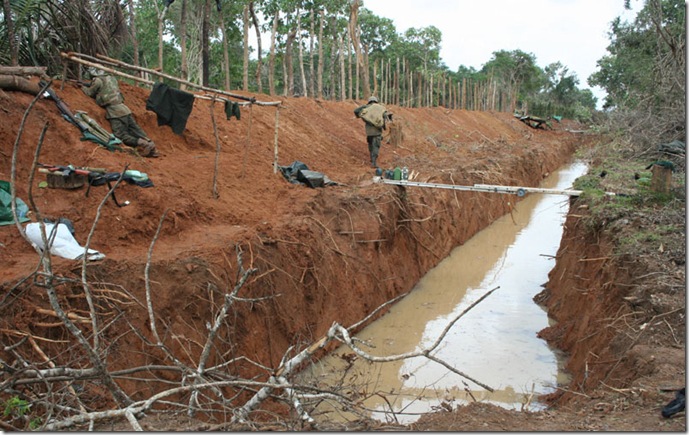
The Stalingrad-esque earth bund at Southern KILINOCHCHI. Source- SLA media.

The Summer of 1942 Hitler's forces occupy western Europe. The previous year Hitler had turned his attention east and launched operation Barbarossa against the Soviets. Initially it sweeps everything before it before the Soviet winter grinds it to a halt when Stalin counter attacked. After stabilising his FDLs and re-equipping his men after the set back at the battle of Moscow, Hitler decides to move South towards the Caucasus to capture the vital Russian oil fields. Friedrich Paulus the commander of the German 6th army was handed the operation to capture the Caucasus. The operation was code named Blue. 

In Paulus's original campaign to take the Caucasus Hitler had not ordered him to consider the Soviet city of Stalingrad to be important. But after the initial success of Blue during the summer Hitler turns his eyes towards Stalingrad. Despite the city not being in initial German plans, Stalingrad with its population of 500000 was a key rail and transport centre on the West bank of the Volga river.

Stalingrad was however not an easy target. It straddles along 20 miles along the precipitous West banks of the Volga. On the North stands the industrial sites of the DZERZHINSKY tractor factory which was now turning out quarter of the red army's tanks and other vehicles, the BARRIKADY arms plant, the Red October steels plant and the LAZUR chemicals plant. All these provided excellent opportunities for the defenders to dig in or to turn them into formidable defensive fortresses. Further South was the city centre. All these make up a lethal labyrinth in which attackers may get pinned down in pre-planned kill zones. Geographically there was another key hurdle Paulus had to face. The Tsaritsa river runs through the city in a 200 foot deep gauge to the Volga river. There are no bridges across the Volga so supplies and people have to be ferried across which should be a major disadvantage for the defenders. But this also meant that unless Paulus's men can cross the Volga they will run the gauntlet of the Soviet guns on the Eastern bank.

In striking a key hub of the enemy such as STALINGRAD the battle planners must be absolutely clear on why they are getting locked into this particularly risky type of operation and how the target fits to the overall battleplan. It is therefore important to the commander who is considering putting his troops into a city to have a clear idea what he is trying to accomplish. In 1942 Stalingrad was not in Hitler's original plan for the Southern area of the Soviet union and his drive to seize the oil fields of the Caucasus. The initial thrust of Operation Blue goes well for Hitler. This apparent success; apparent because the soviets have actually withdrawn to avoid mass loses leads a now confident Hitler to change his plan. He did not want to simply head for the oil fields, instead he wanted to take the whole Caucasus. And to prevent a buildup of Soviet forces there he wanted to take and destroy Stalingrad. But only when the Summer 1942 campaign appears to go well Hitler changed his mind and decided to take the city. This decision proved a serious lack of clarity in Hitler's strategic thinking in 1942. Battle of Stalingrad was really fought as an afterthought at the end of that year. At the beginning of the Summer Hitler really wanted push to the South to the Caucasian mountains and open the gateway to the Middle East and importantly to gain the oil. But there was another reason for Hitler's decision to strike Stalingrad and it was personal. Stalingrad was Stalin's city. He had commanded the city for 4 months during the civil war of 1919-1921. In the summer of 1942 when Soviet resistance to the German advance collapses, Stalin decreed that Stalingrad would be a fortress from which there would be no retreat. And Hitler ordered that the city must fall. So Hitler's decision to strike Stalingrad was partly a personal tussle; dictator against dictator.

At Stalingrad surprise was less important since when Soviet resistance at the German advance collapsed that summer Stalin expected an attack on the city. For General Paulus therefore the vital element was speed and momentum of the attack before Stalingrad's defences can be strengthened. On August 23rd 1942 Paulus launched his attack. But his plans were already in danger due to Hitler's indecision. A month earlier confident that Stalingrad will fall easily Hitler transferred the 4th Panzer brigade South fatally weakening the assault force for Stalingrad. The tank units attacking the Southern part of the city were severely understrength with their crews exhausted. Soviet artillery on the eastern bank of the Volga continued to bombard the German positions. German tanks were bogged down by heaps of rubble and barricades. Where they were able to move forward, they came under Soviet antitank fire from wrecked buildings.They were hemmed in by ravines that criss-crossed the area thus losing the all important impetus and momentum. Only on the last day of August do they breakthrough the outer Soviet defences and advance towards the heart of the city. Paulus's infantry struck between the two German armoured thrusts to push the Soviets into the Volga. But German advances in the South meant that a large Soviet force was left untouched to the North. And Paulus is only too aware of the danger of attacks to his flank and rear by these. This makes him to delay his final push. Its not until September 13th, 21 days after the first advance that he pushes forward reluctantly. But the delay has cost him the essential requirement of speed and given the Soviet defenders vital time. This time allowed the Soviets to deploy the Elite 13th Division in sufficient strength that developed the concept of Kill Zones along heavily mined areas through which on they knew the way to face Paulus's 200000 men. MG posts protruding through windows and anti-tank weapons littered the streets. Snipers also successfully inflicted heavy casualties on the Germans. Notable among them was Vasily Zaytsev. The Soviet Hugging tactics also meant that the Germans had to fight close quarter battles with the Soviets. The Germans used to leave swastika flags spread on the ground to mark ground controlled by them for the Stuka dive bombers but the Soviet tactics meant the Germans had to fight on their own or risk casualties from their own support fire.

In the first days of October Paulus launched what he hopes will be his final offensives against the 3 remaining Soviet strong points. The tractor factory, Red October steel works and the BARRIKADY arms plant. In 10 days half of the Red October plant and most of the BARRIKADY complex have fallen. By early November Paulus had reduced the Soviet held area to two small enclaves, one 8 miles long 1 mile deep and the other even smaller. Paulus appeared to have regained momentum. He seemed to be on the verge of victory. But the winter arrived.

As the winter begins to bite the Soviets continue to cling onto the two small enclaves. Factory workers were repairing damaged Soviet tanks, vehicles and weapons on the battlefield itself. Some volunteered to man tank gun positions. They were holding out and most crucially resupplying over the frozen parts of the Volga and via flotillas of small boats over non-frozen parts.  Protected by gun boats these make over 35000 runs over the Volga bringing supplies and crucially men into Stalingrad. Many were killed as they waited to board the ferries by the Luftwaffe which had complete control of the skies before the winter struck. But still 120000 made it ashore. The Luftwaffe continued their air superiority into early November and Soviet aerial resistance during the day was nonexistent. But due to the heavy volume of 20000 sorties the number of serviceable aircraft of the Luftwaffe fell to 40%. The Kampfwaffe bomber force was hardest hit with almost 50% assets out of service. This was further compounded by  the removal of substantial number of aerial assets for combat in North Africa hence the Germans found their air-arm to be spread thin across Europe and struggled to maintain its strength in the Soviet-German front. This meant the only hindrance to Soviet reinforcements and artillery across the Volga was out of the equation. Meanwhile factory workers repaired damaged Soviet tanks and other weapons close to the battlefield, sometimes on the battlefield itself. These civilians also volunteered as tank crews to replace the dead and wounded, though they had no experience or training in operating tanks during combat

Paulus on the other hand was facing serious resupply problems. His communication line stretched over 800 miles. Bomb damage made it difficult for him to get his supplies through the city. Attrition and the atrocious weather meant the Luftwaffe struggled to maintain the air bridge. But Paulus's real problems haven't even begun. At Stalingrad with his forces locked in battle in the city, Paulus is aware that the Soviets are building up their forces. Jo Stalin as ruthless as ever had turned Stalingrad into a trap. Stalin and his Generals were prepared to sacrifice the men defending the city to annihilate the German army there. He moved troops and equipment into the area secretly. He had moved his reserves from Moscow to the Southern Volga and strengthened the Soviet air arm, the Voenno-Vozdushnye Sily (VVS) at the Stalingrad region with platforms from the entire country. By mid November he had more than a million men, 13500 heavy guns, 900 tanks and 1100 aircraft in position. One Soviet offensive was to strike South East while the Second towards North West and trap the German armies in a lethal pincer movement. Stalin knew this was the best way to trap Paulus and his 6th army since most of the troops locked into Stalingrad were German. But the rest of the front including their all important rear and the flanks where the pincers will move in are held by poorly equipped allies; Romanians, Hungarians and Italians. The Soviets struck in the early morning of November 19th. After 4 days of fighting at the German flanks the two arms of the Red army pincers met. A quarter of a million Germans were now trapped to the East of Stalingrad.

To General Paulus at Stalingrad his exit strategy was clear. He signals Hitler to withdraw his troops from Stalingrad. Instead Hitler accepts Luftwaffe chief Hermann Goring's commitment that his planes can fly in enough supplies and fly out the wounded until Paulus's forces can be relieved and Stalingrad captured. Goring assures Hitler that he can drop 60 tonnes of resupplies everyday. A similar plan had been used successfully a year earlier at the Demyansk Pocket, albeit on a much smaller scale. Also, Soviet fighter forces had improved considerably in both quality and quantity in the intervening year. But the mention of the successful Demyansk air supply operation reinforced Hitler's own views, and was endorsed by Hermann Goring several days later. Despite the bravery of his pilots and crews it was a vain offer. Only one or two days does the Germans receive more than 5 tonnes. As a result there was a massive deficit and one can only wonder where the Germans found the wherewithal to continue the fight. Despite the obvious, Hitler refuses to accept that Paulus and his men faced disaster. He orders Field Marshall Erich Von Manstein to batter the Soviets to a standstill so that Paulus can hold till spring to mount a counter offensive. But in reality all Manstein was able do was to provide Paulus and his besieged men a last chance to save themselves. German panzers seeked to carve a corridor through the Russian lines to give Paulus the way to breakout. They got to just 30 miles of the besieged men before they are halted. But this still gave Paulus a chance of a breakout. Paulus knew his losses would have been massive but he needed authorisation from Hitler for his exit strategy. Manstein also asked for Hitler's permission to authorise the breakout. But Hitler does not even dare to reply. Paulus and his men are forced to fight on. Their situation increasingly became desperate. On Christmas day alone 1280 Germans die of frost bite, Typhus and starvation. To survive they ate their horses, dogs, even the frozen corpses of their dead comrades. Paulus finally surrenders on January 31st. In the 5 months of the Stalingrad campaign 750000 Germans and their allies had lost their lives. Soviets lose the same number including many civilians. In the end 108000 Germans are taken prisoner. Only 5000 returned to see Germany again.

 The Sri Lankan theatre:

5741

The Chinese Parliament: Maj Gen Jagath Dias discussing the second assault on the bund from Southern KILINOCHCHI with 574 brigade. Such discussions meant that unit leaders on the scene were making their own decisions, seizing fleeting opportunities and exploiting any weakness of the enemy. Source- SLA media

Just like Stalin had said that there will be no retreat from Stalingrad  the ever elusive Tamil Tiger leader too made a similar decree that the fall of the KILINOCHCHI town was merely a day dream of the Sri Lankan Commander in Chief. But unlike Hitler who lacked a clarity in his overall theatre wide ambitions, the Sri Lankan Commanders knew exactly what their overall objectives were and what the exact strike points were to have a domino effect on Tamil Tiger defensive positions.

The vital PARANTHAN junction situated North of KILINOCHCHI proved to be the grounds of utmost tactical importance to the Sri Lankan forces since the fall of this vital junction opens the gateway; the A35 to the dense jungles of MULLATIVU, opens up the rear of the impregnable Tamil Tiger National Front via the A9 North and most importantly for the KILINOCHCHI objective - makes the KILINOCHCHI town a massive salient. A salient in military parlance is a vulnerability that any commander cannot ignore. Any troops or assets positioned in a salient must be evacuated because it is surrounded by 3 sides and risks being 'pinched out'.

With this important potential exploit in mind the battle planners set to work.

First among the objectives was to secure a stable MSR close as much as to the theatre of operations. This objective fell on 574 which secured the TERUMURIKANDY Kovil junction on December 10th while the other two arms 571 and 572 kept on the pressure on the Tamil Tiger earth bund from the West and South West. This ensured the A9 was available for supplies and casualty evacuation since the available jungle routes were in dire straits due to the incessant rains.

One of the prime requirements of an assault on a highly defended town/city as explained above is to have surprise, speed and to maintain that speed and momentum not giving the defender sufficient time to further strengthen the defence. With 57 Division completely breaching the earth bund at AKKARAYANKULAM in September 08, it was no surprise for the Tamil Tigers as to where its next objective lay and hence even before the AKKARAYANKULAM bund was breached heavy earth moving equipment and civilians were brought into construct the L bund running all the way from the JAFFNA lagoon to the IRANAMADU tank. Having breached the AKKARAYANKULAM bund the 571/572 and 574 began its advanced scouting and mapping of the Tamil Tiger defences along with their own crumbling type operations to master their opening game as part of their war gaming process. This was while 58 Division made speedy progress to capture the POONERYN sector and reach the Earth bund that stood between them and PARANTHAN across the B69. In addition to the bund, a massive stream of water lay in front of them. Most of these waters came from the overflowing IRANAMADU tank which the Tamil Tigers had opened the sluice gates to the full. Tactical it may sound, however the heavy rains wouldn't have allowed the Tamil Tigers any other option but to open the sluice even if 58 troops were not stationed on the B69.

Once 57 had laid the groundwork for a final assault it was not allowed to breach the L bund on its own before 58 reached it from the Northern end for several reasons.

  1. If 57 had initiated an assault on the L bund on its own the Tamil Tigers may have opted to withdraw from the bund as well as from the KILINOCHCHI town itself thus allowing 57 to expose their Northern flank and position itself as a salient. Armed with a fresh consignment of artillery and mortar shells the Tamil Tigers could have made light work of 57 troops and trapped them within KILINOCHCHI pretty much the same way the German 6th army was trapped in Stalingrad in 1942.
  2. If 57 had engaged KILINOCHCHI on its own, the Tamil Tigers would still have had easy access for reinforcements/supplies along the A9 North. Prior to the battle it was very well known that the Tamil Tigers were using the same reserve forces in defending KILINOCHCHI as well as the National Front. Harsh weather had made most of the routes impassable. Therefore the A9 was invaluable particularly through the marshy lagoon at EPS to re-induct reserve cadre to each battlezone depending on the need. Hence it was paramount to disable the Tamil Tigers ability to use the A9 connecting two theatres.
  3. The battle planners knew that 58 Division's pressure and capture of PARANTHAN would make the KILINOCHCHI town limits a salient to the Tamil Tiger positions. Any stringent defences or kill zones the Tamil Tigers may have had in store for the Sri Lankan forces within the town limits were forced to dissolve with 58's move further North. One may argue that the Sri Lankan forces should have engaged the enemy without letting it flee, however it must be emphasised that battle in urban environments is the most vicious form of warfare. The commanders must be clear on why they are committing their troops to this very risky and dangerous form of warfare where fighting may rage street by street, house by house even down to room by room. Therefore it was important to minimise confrontation within the town limits as much as possible.

On the 16th of December 08 despite the adverse weather the well coordinated assault on the L bund commenced. The assault in the midst of the heavy monsoons added the element of surprise to the Sri Lankan battleplanners. During the battle of Cambrai in the early morning of November 20th 1917 Hindenberg did not expect the Allied Commander Haig to launch an assault for the approaching winter usually signaled an end to the campaigning season until the spring next year. A similar surprise element was added by the Tamil Tigers during their failed JAFFNA offensive of August 2006 during the low tide season in an attempt to outflank the KILALY FDL by conducting a beach landing.

The element of surprise was further enhanced by a hurricane barrage on Tamil Tiger strongpoints. The hallmark of Indirect fire support throughout history has been its inaccuracy and the requirement of enormous amounts of time and ammunition thereby giving away the attacker's objective and allowing the defender to counterconcentrate. The Hurricane barrages are not intended to destroy the enemy objective but suppress it enough while small units work their way forward. Such suppression must be maintained until the target objective is overrun and lifted to extend the coverage and to allow the assault team to reach the objective without taking casualties from friendly fire. This is in addition to the SLAF's role in providing excellent CAS despite the unfavourable weather to keep the enemy's heads down and break their will to resist . Such combined arms manoeuvres requires tremendous coordination.

The assault was initially conducted by a fixing assault courtesy of the combination of 53 and 55 Divisions stationed along the KILALY/MUHAMALE/NK axis by signaling an attempted breakthrough. This move prompted the Tamil Tigers to deploy its reserves to prevent a breakthrough by these two Divisions and were compelled to fix the reserves into position thereby preventing them from counterconcentrating at the L bund. With this opportune moment the 58 and 57 Division combined initiated their assault on the L bund. Well trained infantry teams spearheaded by Commandos and Special forces using cover and concealment headed towards their each individual objectives. In some locations sappers had cleared approach pathways under cover of darkness or smoke, some locations scouts had mapped pathways and some locations it was down to bangalore torpedos and saturation techniques. The extensive rehearsals conducted using captured earth bunds meant that even junior soldiers were trained well enough to operate independently in small units, using their own tactical judgement to solve problems and keep the assault moving forward, for any bogged down strike team on unfavourable ground can leave the team and the mission highly vulnerable. The units engaged in battle were so professional that unit leaders on the scene were making their own decisions, seizing fleeting opportunities and exploiting any weakness of the enemy even if it meant a slight change to the original approach. The assault was so successful that some points along the bund fell in a small matter of 15 minutes.

The well dispersed infantry teams meant the Tamil Tiger indirect fire support were highly negated. Dispersion reduces vulnerability by putting fewer targets in the splash damage radius of an incoming shell. Artillery was never meant to target small units of soldiers. They are meant to target the centroid of formations.
It is hard to target these highly mobile assault teams. Hence the Tamil Tigers directed at the one thing that is not mobile, their own earthbund and its strongpoints which were captured by the initial assault. These defences were further strengthened with mobile MG posts stationed on top and behind the earth bund to bring down any attacker who managed to overcome the initial defences. The MG posts behind the bund were missed out by recce teams since the huge earth mound had obscured their Line of Sight (LOS). Machine guns are direct fire-flat trajectory weapons and attackers can use directional cover by obscuring the line of sight (LOS). Mortars and artillery on the other hand can fire over intervening obstacles and engage targets without LOS. Hence working together, machine guns and artillery/mortars compliments for each other's weaknesses. Such interlocking fields of fire reduces the cover or dead space thus complicates things for the attacker to find and exploit concealed positions.

However, the incessant monsoons meant the the MUHAMALE axis was highly unfavourable to conduct the special infantry/mechanised warfare. The marshy kadol area had made a sizeable chunk of land to be submerged making forward movement and casualty evacuation a nightmare for forward field operatives. Using their experience and judgement the commanders were compelled to reach the Clausewitz's culminating point and pull back. This relieved a substantial amount of Tamil Tiger reserves and allowed them to counterconcentrate against 571 and 572 and by Saturday the 20th of December they managed to counterconcentrate against 574. The counterstrikes by the Tamil Tigers were aimed at achieving one objective. That was to regain the breachheads which the Sri Lankan forces would have otherwise used to pour in exploitation forces behind the enemy line to disrupt the Tamil Tiger FDL and render it incapable of fighting at full efficiency. Similar countertsrikes were conducted prior by the Tamil Tigers during the assault on the NACHCHIKUDA-AKKARAYAN earth bund. What made the difference this time was the heavy volume of mortar fire. The rate of fire at one grid location alone amounted to average 4 mortars per minute. Once the Sri Lankan forces withdrew from the breach heads the mortar fire concentrated ahead of the earth bunds with a reduced rate of around 4 mortars every 5-10 minutes. Exploiting the instrumental limitations on rough monsoonal seas the Tamil Tigers had managed to smuggle in a consignment of shells to maintain their high firing rate. However they were unable to persist with this rate since the Navy managed to intercept the floating warehouse on the 20th of December 08 some 70NMs off the MULLATIVU coast. After this interception, a significant reduction of Tamil Tiger fire support firing rates were observed.

After the bund was breached within the next ten days of fighting 58 initiated the task of assaulting the strategic PARANTHAN junction. This was achieved by isolating the junction by cutting off the A9 from the North from THADDUVANKODDI and KOMARIKUDAKULAM. This move also ensured that the Sri Lankan forces were in hold of the high ground of KOMARIKUDAKULAM which later came in handy for laying siege on the former 54 Division HQ at ELEPHANTPASS. By January 1st 2009 the Tamil Tigers were compelled to withdraw from the PARANTHAN junction and by next day they withdrew from the KILINOCHCHI town limits. The minor skirmishes faced by the advancing 571 and 572 troops were to ensure the Tamil Tiger rear units had made a safe withdrawal.

When the Sri Lankan forces had managed to divert and pin down reinforcements with 53/55 thereby siphoning forces away from major efforts while severely disrupting the enemy supplies by intercepting key routes and sea supplies, Paulus's German 6th army did not achieve this requirement. The Eastern bank of Volga was strategically important for the Soviets in this sense as this did not allow the Germans to cross over to the Eastern bank. Even though the Stukas had wreaked much havoc during the summer, it could not maintain its momentum and keep the supplies across the Volga in check. The SLAF however played a pivotal role. If high altitude SLAF operations during Eelam War III had stifled the SLAF's ability to provide effective Close Air Support, the current SLAF was a farcry to the previous era and were more than willing to 'get down there' to add the necessary punch. The results of SLAF sorties were also down to superior tactics and ordnance.

Just like the Sri Lankan armed forces the German military doctrine was based on combined arms teams with close support provided by tanks, artillery and aircraft. To counter this the Soviets had employed hugging tactics and killzones within Stalingrad to ensure fighting raged on house to house and room to room. When in 1942 the Soviets had a 80Km length of STALINGRAD and hence depth to grind the Germans down till the winter arrived, the Tamil Tigers had only 8Km of the town straddling along the A9 to grind down the Sri Lankan forces. 582 from the North, 571 from the West, 572 from the South West and 574 from the Southern edge of the town meant the Tamil Tigers had no defence in depth of the town at all compared to the depth the Soviets enjoyed at STALINGRAD. Furthermore strategically the Volga river ensured the Germans failed to completely cutoff the city from the Soviet mainland. Whereas in the Sri Lankan theatre even though the forces had not completely cut off either PARANTHAN or KILINOCHCHI, it had done enough to disrupt the fluid defence of the Tamil Tigers set up by the mobile reserves that switched theatres upon requirement and resupplies via the sea.

Hitler's lack of clarity of the overall battleplan meant that the Germans were compelled to sacrifice many of its experienced troops and other assets to fight on among the rubble of a city which was strategically insignificant. Rather than pinning down his forces in a ferocious street battle, Hitler could have heeded his commanders' advice and bypassed Stalingrad altogether to concentrate his total force on the Caucasus and the oil fields. The Sri Lankan battle planners however at any moment did not deviate from their overall objectives. They were very well aware that KILINOCHCHI was of little military value, however the fierce resistance of the Tamil Tigers especially of its highly valued reserves meant that it gave the battleplanners an opportunity to eliminate as much as reserves as possible then and there rather than engaging them again at the new defences that are coming up circumventing the MULLATIVU jungles. Furthermore was the fact that the KILINOCHCHI town being 8Kms in length meant 57 had to cross the town and its surrounding bund if it were to add pressure on the MULLATIVU jungles. Having also an eye towards preserving the town buildings as much as possible and avoiding a heap of rubble as in STALINGRAD the battleplanners took steps to avoid confrontations within the town. In addition to limiting collateral damage, as mentioned above, urban battle is the most vicious form of warfare and it is paramount that any commander avoid it as much as possible. Unlike in STALINGRAD the Tamil Tiger defences within the town dissolved once 58 Division had captured the PARANTHAN junction and making the KILINOCHCHI area into a salient.

There is no doubt the Tamil Tigers were intending to make KILINOCHCHI the crowning moment of their defensive battleplan. There are many facets of a defensive battleplan. One is to entice the enemy towards you to maintain the initiative to give the enemy an idea of vulnerability but to draw them into a situation from which they cannot return and then to launch a spectacular counterstrike. The other is to wear the enemy off by building strong defensive positions that fighting against them would cause the enemy huge casualties and huge distress. Whichever option the defending commander chooses, he always has to choose a spectacular counter attack as the end game. Such a counterstrike at any stages remains the crucial factor in the defensive battle, battleplan. It is almost always the last act. However the great danger of this battleplan is that the defensive battle commander may never really know the enemy's full intentions. It very well might be the enemy who actually has the initiative intending to pin the defensive forces down and outflank them from elsewhere.

Once Paulus was trapped by the Soviets at STALINGRAD Hitler swiftly promoted Paulus to the rank of Field Marshall. With no German officer of this rank having ever surrendered, with the promotion Hitler had made clear to Paulus what he had to do. However being let down by the Führer due to his lack of clarity in the overall battleplan and for not authorising the breakthrough at the opportune moment had greatly disappointed Friedrich Paulus. Instead of turning the gun on himself he surrendered with his men famously saying "I have no intention of shooting myself for that Austrian corporal". He later became a vociferous critic of the Nazis and joined the National Committee for a Free Germany.

With the Sri Lankan military juggernaut eating away the Tamil Eelam territory it will not be long before Tamil Tiger higher echleons will face the same dilemma as that of Friedrich Paulus on whether to stay faithful to its leader and fight till the end for a lost cause or to opt for a headline creating defection/surrender thus putting an end to the bloodshed of prospectful youth that has held back Sri Lanka's development for quarter of a century. Only time will tell...

Wednesday, 5 November 2008

The March to Pooneryn and beyond

58 copy

Up until November 1993 the POONERYN defence complex formed a complementary defence mechanism encompassing EPS and the Jaffna islets in safeguarding the peninsula from the Tamil Tigers. Since the fall of the POONERYN defence complex, it has been of immense strategical value to the Tamil Tigers providing it with a base to disrupt the naval/air bridge connecting the Jaffna peninsula with the South using its T59I 130mm howitzers and coastal littorals to launch its Sea Tiger assets and smuggling operations.

Pooneryn defence complex used to overlook the Jaffna/Kilaly lagoon and proved to be the nemesis for Tamil Tigers' free movement/logistics activities in this sector. It also proved to be a hindrance for Tamil Tiger radio traffic between Wanni mainland and the Jaffna peninsula which, barring the PALAY/KKS HSZ, was under complete control of the Tamil Tigers. This was the primary reason for Operation Thavalai (frog) to take place to overwhelm this isolated defence complex. This land mass also provided a suitable base for the Tamil Tigers to use the T-59I 130mm howitzers to disrupt the vital air/naval bridge at PALALY/KKS HSZ and any other target that falls within in its range spectrum. It also proved useful for launching its sea tiger assets during its many assaults on Jaffna islets and during its failed Jaffna offensive of 2006.

With 58 Division making headway along the A32 bagging Tamil Tiger bases at VIDALATHIVU, ILLUPPAKADAVAI, VELLANKULAM, MULANKAVIL in a matter of weeks, the Tamil Tigers possibly borrowing a leaf out of Hindenberg's book set about to build their own Hindenberg line from PANDIVEDDIKULAM to AKKARANKULAM west, fortified with bunkers, deep trenches. The machine gun posts were positioned such that it severely limited the attacker's ability to exploit cover by providing interlocking fields of fire.

Despite its immense fortification, the troops of 58 many months ago succeeded in punching through certain points along this earth bund and held on while the rear was exploited. Such limited 'bite and hold' operations are means to exploit and seize terrain which were major sections of the Tamil Tiger's defensive positions and considered important by the SLA battleplanners. The advantage of such limited ops is that it avoids the SLA overstretching themselves hence reducing its vulnerability to an impending counterattack. Soon as the 58 Division troops took up positions, the Tamil Tigers using its elites launched its own limited counterattacks to regain the lost strongpoints along the bund, without any success. One such area was the KARAMBAKULAM area where the Tamil Tigers had used the tank bund of the defunct reservoir for its defensive purposes. This area was breached on the 17th of September 08 with much sacrifice.

Through the exploited KARAMBAKULAM area troops of 582 and 583  forged ahead. While 581 lay siege on the NACHCHIKUDA jetty from the South and the East, 583 moved North ahead of the earth bund and cut the A32 from the North of the NACHCHIKUDA base.

Meanwhile 582 concentrated on expanding the breach head. A narrow penetrative corridor such as the one at KARAMBAKULAM means that there are fewer smaller routes of access for supplies. Fewer smaller routes of supplies means the troops that poured in through the defences or exploitation forces in military parlance will move slower with slower commitment. A small supply route also means, it can only sustain a smaller exploitation force. Further such a narrow frontage means it increases the vulnerability of a potential counterattack for, the counterattacking Tamil Tigers require to only advance a short distance to cut the supply route.  Mobilising troops through a narrow breach of a formidable defence line without further expanding the penetrative corridor always inherently risky. This is the reason why troops of 582 along with 571 troops of the 57 Division set about to completely dismantle the Tamil Tiger earth bund by expanding their punch holes in pre-determined stages. This was a slow process.

In order to achieve the objective by destroying the hostile forces while preserving as much as SLA's own, increasing the ability to take and hold ground in minimum time; 582 ventured North towards MANNIYANKULAM, KUCHCHUKKULAM, NOCHCHIMODDAI and ANAIVILUNTHAN - North of KARAMBAKULAM to disrupt the flow of reinforcements and engage them North of the objective and make them battle fatigued by the time they reached the defenders at the earth bund.

There was another objective in this move. MANNIYANKULAM holds a five way junction located 4Kms North of KARAMBAKULAM. This junction from the West connects to the A-32 road at the 11th and 12th mile posts, from the North to the Pooneryn - Paranthan road and from the South to the Akkarayankulam road. Hence this area alone provides the 58 battleplanners many avenues of approach for the future.

One such avenue - the PARANTHAN-POONERYN road- bears the potential to cut off the entire POONERYN peninsula from the Tamil Tiger controlled Wanni and bring forth 58 Division's  long term objective - POONERYN. Once this road in under control it provides the SLA battleplanners the opportunity to enter the North of KILINOCHCHI town via PARANTHAN which once housed the outermost satellite camp of the EPS base complex.

With the fall of NACHCHIKUDA on the 30th of October, 58 Division can be expected to lay siege on the VALLAIPADU sea tiger jetty located North West of NACHCHIKUDA. The PALAVI jungle areas surrounding VALLAIPADU is ideal for SLA's small unit independent manoeuvres, making it effective for cover and concealment. Even though a direct route exists to VALLAIPADU from the VALLAIPADU junction located South of JEYAPURAM, the current SLA strategy involves small units to leave exposed land and roads and take circuitous routes. Such routes require accurate ground reconnaissance, advanced scouting to map out minefields, enemy positions and strongpoints, prepositioning and rehearsals. All this in reality accounts for more time than the actual assault. However if 58 forges ahead up the A32 up to PALLIKUDA the entire DEVIL'S POINT landmass will be cut off from the Wanni mainland. Such a move will also prevent the Tamil Tigers from fortifying its positions close to POONERYN and will render the VALLAIPADU jetty inoperable with no land route available.

The advantages to the military establishment of the fall of POONERYN is manifold.

  1. Opens up a land based MSR across the SANGUPIDDY-KERATIVU jetty linking POONERYN to the JAFFNA mainland.
  2. Thus reduces the workload of the Navy and SLAF in maintaining the bridge across the sea and air.
  3. The Tamil Tigers are set to lose its entire Western Coast and hence a logistical nightmare to its sea faring wing in smuggling its supplies from the TamilNadu warehouses.
  4. Provides the SLN to establish itself again at NAGATHEVANTHURAI overlooking the KILALY lagoon thus an observation point against Tamil Tiger infiltrations towards the Jaffna peninsula.
  5. And allows the SLN to block any refugee or fleeing Tamil Tigers cadres from entering Tamil Nadu.
  6. Provides the 51 Division which is based in the WALIKAMAM area to expand across the lagoon and perform holding duties.
  7. Puts the Tamil Tiger long range T59I 130mm howitzers out of the range of vital security establishments within the peninsula.
  8. Provides vital intelligence to the military establishment on Tamil Tiger artillery pillboxes at K-point
  9. Allows the 58 Division to concentrate on areas North of KILINOCHCHI along the POONERYN-PARANTHAN road
  10. Removes the Tamil Tiger artillery and W86 120mm heavy mortar pads that were within range of the operations sphere of 55/53 Divisions
  11. And provides the SLA additional fire support bases to conduct suppressive fire towards known enemy fire support locations.

Since the days the earth bund was pierced, the Tamil Tigers made sure they repositioned their long range artillery from POONERYN's K point. Currently they are stationed at a location East of PARANTHAN giving the Tamil Tigers the opportunity to engage 55 troops at MUHAMALAI, 57 troops operating at AKKARAYAN, 58 troops operating at NOCHCHIMODDAI and 59 troops IF they manage to enter areas North of the Nayaru lagoon.

If 58 Division decides to move East once it has achieved its objective and reaches PARANTHAN, the Tamil Tigers stationed at the former EPS complex may face the same harsh annihilation endured by the 54 Division troops at EPS in April 2000. That is of course, is if 53/55 commanders decide to position the 58 Division at PARANTHAN during their war gaming process. With the current mood among troops operating various crumbling operations at the National Front translating to something like "if we breakthrough, only 59 will stop us", the day the national front will flare up again is not far off.

As always only time will tell...