
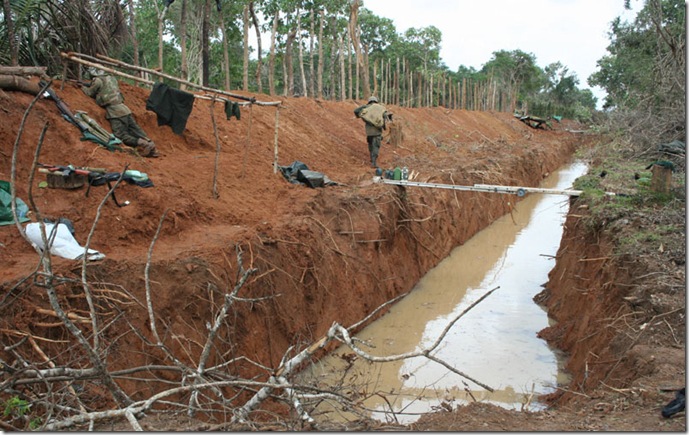
The Stalingrad-esque earth bund at Southern KILINOCHCHI. Source- SLA media.
The Summer of 1942 Hitler's forces occupy western Europe. The previous year Hitler had turned his attention east and launched operation Barbarossa against the Soviets. Initially it sweeps everything before it before the Soviet winter grinds it to a halt when Stalin counter attacked. After stabilising his FDLs and re-equipping his men after the set back at the battle of Moscow, Hitler decides to move South towards the Caucasus to capture the vital Russian oil fields. Friedrich Paulus the commander of the German 6th army was handed the operation to capture the Caucasus. The operation was code named Blue.
In Paulus's original campaign to take the Caucasus Hitler had not ordered him to consider the Soviet city of Stalingrad to be important. But after the initial success of Blue during the summer Hitler turns his eyes towards Stalingrad. Despite the city not being in initial German plans, Stalingrad with its population of 500000 was a key rail and transport centre on the West bank of the Volga river.
Stalingrad was however not an easy target. It straddles along 20 miles along the precipitous West banks of the Volga. On the North stands the industrial sites of the DZERZHINSKY tractor factory which was now turning out quarter of the red army's tanks and other vehicles, the BARRIKADY arms plant, the Red October steels plant and the LAZUR chemicals plant. All these provided excellent opportunities for the defenders to dig in or to turn them into formidable defensive fortresses. Further South was the city centre. All these make up a lethal labyrinth in which attackers may get pinned down in pre-planned kill zones. Geographically there was another key hurdle Paulus had to face. The Tsaritsa river runs through the city in a 200 foot deep gauge to the Volga river. There are no bridges across the Volga so supplies and people have to be ferried across which should be a major disadvantage for the defenders. But this also meant that unless Paulus's men can cross the Volga they will run the gauntlet of the Soviet guns on the Eastern bank.
In striking a key hub of the enemy such as STALINGRAD the battle planners must be absolutely clear on why they are getting locked into this particularly risky type of operation and how the target fits to the overall battleplan. It is therefore important to the commander who is considering putting his troops into a city to have a clear idea what he is trying to accomplish. In 1942 Stalingrad was not in Hitler's original plan for the Southern area of the Soviet union and his drive to seize the oil fields of the Caucasus. The initial thrust of Operation Blue goes well for Hitler. This apparent success; apparent because the soviets have actually withdrawn to avoid mass loses leads a now confident Hitler to change his plan. He did not want to simply head for the oil fields, instead he wanted to take the whole Caucasus. And to prevent a buildup of Soviet forces there he wanted to take and destroy Stalingrad. But only when the Summer 1942 campaign appears to go well Hitler changed his mind and decided to take the city. This decision proved a serious lack of clarity in Hitler's strategic thinking in 1942. Battle of Stalingrad was really fought as an afterthought at the end of that year. At the beginning of the Summer Hitler really wanted push to the South to the Caucasian mountains and open the gateway to the Middle East and importantly to gain the oil. But there was another reason for Hitler's decision to strike Stalingrad and it was personal. Stalingrad was Stalin's city. He had commanded the city for 4 months during the civil war of 1919-1921. In the summer of 1942 when Soviet resistance to the German advance collapses, Stalin decreed that Stalingrad would be a fortress from which there would be no retreat. And Hitler ordered that the city must fall. So Hitler's decision to strike Stalingrad was partly a personal tussle; dictator against dictator.
At Stalingrad surprise was less important since when Soviet resistance at the German advance collapsed that summer Stalin expected an attack on the city. For General Paulus therefore the vital element was speed and momentum of the attack before Stalingrad's defences can be strengthened. On August 23rd 1942 Paulus launched his attack. But his plans were already in danger due to Hitler's indecision. A month earlier confident that Stalingrad will fall easily Hitler transferred the 4th Panzer brigade South fatally weakening the assault force for Stalingrad. The tank units attacking the Southern part of the city were severely understrength with their crews exhausted. Soviet artillery on the eastern bank of the Volga continued to bombard the German positions. German tanks were bogged down by heaps of rubble and barricades. Where they were able to move forward, they came under Soviet antitank fire from wrecked buildings.They were hemmed in by ravines that criss-crossed the area thus losing the all important impetus and momentum. Only on the last day of August do they breakthrough the outer Soviet defences and advance towards the heart of the city. Paulus's infantry struck between the two German armoured thrusts to push the Soviets into the Volga. But German advances in the South meant that a large Soviet force was left untouched to the North. And Paulus is only too aware of the danger of attacks to his flank and rear by these. This makes him to delay his final push. Its not until September 13th, 21 days after the first advance that he pushes forward reluctantly. But the delay has cost him the essential requirement of speed and given the Soviet defenders vital time. This time allowed the Soviets to deploy the Elite 13th Division in sufficient strength that developed the concept of Kill Zones along heavily mined areas through which on they knew the way to face Paulus's 200000 men. MG posts protruding through windows and anti-tank weapons littered the streets. Snipers also successfully inflicted heavy casualties on the Germans. Notable among them was Vasily Zaytsev. The Soviet Hugging tactics also meant that the Germans had to fight close quarter battles with the Soviets. The Germans used to leave swastika flags spread on the ground to mark ground controlled by them for the Stuka dive bombers but the Soviet tactics meant the Germans had to fight on their own or risk casualties from their own support fire.
In the first days of October Paulus launched what he hopes will be his final offensives against the 3 remaining Soviet strong points. The tractor factory, Red October steel works and the BARRIKADY arms plant. In 10 days half of the Red October plant and most of the BARRIKADY complex have fallen. By early November Paulus had reduced the Soviet held area to two small enclaves, one 8 miles long 1 mile deep and the other even smaller. Paulus appeared to have regained momentum. He seemed to be on the verge of victory. But the winter arrived.
As the winter begins to bite the Soviets continue to cling onto the two small enclaves. Factory workers were repairing damaged Soviet tanks, vehicles and weapons on the battlefield itself. Some volunteered to man tank gun positions. They were holding out and most crucially resupplying over the frozen parts of the Volga and via flotillas of small boats over non-frozen parts. Protected by gun boats these make over 35000 runs over the Volga bringing supplies and crucially men into Stalingrad. Many were killed as they waited to board the ferries by the Luftwaffe which had complete control of the skies before the winter struck. But still 120000 made it ashore. The Luftwaffe continued their air superiority into early November and Soviet aerial resistance during the day was nonexistent. But due to the heavy volume of 20000 sorties the number of serviceable aircraft of the Luftwaffe fell to 40%. The Kampfwaffe bomber force was hardest hit with almost 50% assets out of service. This was further compounded by the removal of substantial number of aerial assets for combat in North Africa hence the Germans found their air-arm to be spread thin across Europe and struggled to maintain its strength in the Soviet-German front. This meant the only hindrance to Soviet reinforcements and artillery across the Volga was out of the equation. Meanwhile factory workers repaired damaged Soviet tanks and other weapons close to the battlefield, sometimes on the battlefield itself. These civilians also volunteered as tank crews to replace the dead and wounded, though they had no experience or training in operating tanks during combat
Paulus on the other hand was facing serious resupply problems. His communication line stretched over 800 miles. Bomb damage made it difficult for him to get his supplies through the city. Attrition and the atrocious weather meant the Luftwaffe struggled to maintain the air bridge. But Paulus's real problems haven't even begun. At Stalingrad with his forces locked in battle in the city, Paulus is aware that the Soviets are building up their forces. Jo Stalin as ruthless as ever had turned Stalingrad into a trap. Stalin and his Generals were prepared to sacrifice the men defending the city to annihilate the German army there. He moved troops and equipment into the area secretly. He had moved his reserves from Moscow to the Southern Volga and strengthened the Soviet air arm, the Voenno-Vozdushnye Sily (VVS) at the Stalingrad region with platforms from the entire country. By mid November he had more than a million men, 13500 heavy guns, 900 tanks and 1100 aircraft in position. One Soviet offensive was to strike South East while the Second towards North West and trap the German armies in a lethal pincer movement. Stalin knew this was the best way to trap Paulus and his 6th army since most of the troops locked into Stalingrad were German. But the rest of the front including their all important rear and the flanks where the pincers will move in are held by poorly equipped allies; Romanians, Hungarians and Italians. The Soviets struck in the early morning of November 19th. After 4 days of fighting at the German flanks the two arms of the Red army pincers met. A quarter of a million Germans were now trapped to the East of Stalingrad.
To General Paulus at Stalingrad his exit strategy was clear. He signals Hitler to withdraw his troops from Stalingrad. Instead Hitler accepts Luftwaffe chief Hermann Goring's commitment that his planes can fly in enough supplies and fly out the wounded until Paulus's forces can be relieved and Stalingrad captured. Goring assures Hitler that he can drop 60 tonnes of resupplies everyday. A similar plan had been used successfully a year earlier at the Demyansk Pocket, albeit on a much smaller scale. Also, Soviet fighter forces had improved considerably in both quality and quantity in the intervening year. But the mention of the successful Demyansk air supply operation reinforced Hitler's own views, and was endorsed by Hermann Goring several days later. Despite the bravery of his pilots and crews it was a vain offer. Only one or two days does the Germans receive more than 5 tonnes. As a result there was a massive deficit and one can only wonder where the Germans found the wherewithal to continue the fight. Despite the obvious, Hitler refuses to accept that Paulus and his men faced disaster. He orders Field Marshall Erich Von Manstein to batter the Soviets to a standstill so that Paulus can hold till spring to mount a counter offensive. But in reality all Manstein was able do was to provide Paulus and his besieged men a last chance to save themselves. German panzers seeked to carve a corridor through the Russian lines to give Paulus the way to breakout. They got to just 30 miles of the besieged men before they are halted. But this still gave Paulus a chance of a breakout. Paulus knew his losses would have been massive but he needed authorisation from Hitler for his exit strategy. Manstein also asked for Hitler's permission to authorise the breakout. But Hitler does not even dare to reply. Paulus and his men are forced to fight on. Their situation increasingly became desperate. On Christmas day alone 1280 Germans die of frost bite, Typhus and starvation. To survive they ate their horses, dogs, even the frozen corpses of their dead comrades. Paulus finally surrenders on January 31st. In the 5 months of the Stalingrad campaign 750000 Germans and their allies had lost their lives. Soviets lose the same number including many civilians. In the end 108000 Germans are taken prisoner. Only 5000 returned to see Germany again.
The Sri Lankan theatre:

The Chinese Parliament: Maj Gen Jagath Dias discussing the second assault on the bund from Southern KILINOCHCHI with 574 brigade. Such discussions meant that unit leaders on the scene were making their own decisions, seizing fleeting opportunities and exploiting any weakness of the enemy. Source- SLA media
Just like Stalin had said that there will be no retreat from Stalingrad the ever elusive Tamil Tiger leader too made a similar decree that the fall of the KILINOCHCHI town was merely a day dream of the Sri Lankan Commander in Chief. But unlike Hitler who lacked a clarity in his overall theatre wide ambitions, the Sri Lankan Commanders knew exactly what their overall objectives were and what the exact strike points were to have a domino effect on Tamil Tiger defensive positions.
The vital PARANTHAN junction situated North of KILINOCHCHI proved to be the grounds of utmost tactical importance to the Sri Lankan forces since the fall of this vital junction opens the gateway; the A35 to the dense jungles of MULLATIVU, opens up the rear of the impregnable Tamil Tiger National Front via the A9 North and most importantly for the KILINOCHCHI objective - makes the KILINOCHCHI town a massive salient. A salient in military parlance is a vulnerability that any commander cannot ignore. Any troops or assets positioned in a salient must be evacuated because it is surrounded by 3 sides and risks being 'pinched out'.
With this important potential exploit in mind the battle planners set to work.
First among the objectives was to secure a stable MSR close as much as to the theatre of operations. This objective fell on 574 which secured the TERUMURIKANDY Kovil junction on December 10th while the other two arms 571 and 572 kept on the pressure on the Tamil Tiger earth bund from the West and South West. This ensured the A9 was available for supplies and casualty evacuation since the available jungle routes were in dire straits due to the incessant rains.
One of the prime requirements of an assault on a highly defended town/city as explained above is to have surprise, speed and to maintain that speed and momentum not giving the defender sufficient time to further strengthen the defence. With 57 Division completely breaching the earth bund at AKKARAYANKULAM in September 08, it was no surprise for the Tamil Tigers as to where its next objective lay and hence even before the AKKARAYANKULAM bund was breached heavy earth moving equipment and civilians were brought into construct the L bund running all the way from the JAFFNA lagoon to the IRANAMADU tank. Having breached the AKKARAYANKULAM bund the 571/572 and 574 began its advanced scouting and mapping of the Tamil Tiger defences along with their own crumbling type operations to master their opening game as part of their war gaming process. This was while 58 Division made speedy progress to capture the POONERYN sector and reach the Earth bund that stood between them and PARANTHAN across the B69. In addition to the bund, a massive stream of water lay in front of them. Most of these waters came from the overflowing IRANAMADU tank which the Tamil Tigers had opened the sluice gates to the full. Tactical it may sound, however the heavy rains wouldn't have allowed the Tamil Tigers any other option but to open the sluice even if 58 troops were not stationed on the B69.
Once 57 had laid the groundwork for a final assault it was not allowed to breach the L bund on its own before 58 reached it from the Northern end for several reasons.
- If 57 had initiated an assault on the L bund on its own the Tamil Tigers may have opted to withdraw from the bund as well as from the KILINOCHCHI town itself thus allowing 57 to expose their Northern flank and position itself as a salient. Armed with a fresh consignment of artillery and mortar shells the Tamil Tigers could have made light work of 57 troops and trapped them within KILINOCHCHI pretty much the same way the German 6th army was trapped in Stalingrad in 1942.
- If 57 had engaged KILINOCHCHI on its own, the Tamil Tigers would still have had easy access for reinforcements/supplies along the A9 North. Prior to the battle it was very well known that the Tamil Tigers were using the same reserve forces in defending KILINOCHCHI as well as the National Front. Harsh weather had made most of the routes impassable. Therefore the A9 was invaluable particularly through the marshy lagoon at EPS to re-induct reserve cadre to each battlezone depending on the need. Hence it was paramount to disable the Tamil Tigers ability to use the A9 connecting two theatres.
- The battle planners knew that 58 Division's pressure and capture of PARANTHAN would make the KILINOCHCHI town limits a salient to the Tamil Tiger positions. Any stringent defences or kill zones the Tamil Tigers may have had in store for the Sri Lankan forces within the town limits were forced to dissolve with 58's move further North. One may argue that the Sri Lankan forces should have engaged the enemy without letting it flee, however it must be emphasised that battle in urban environments is the most vicious form of warfare. The commanders must be clear on why they are committing their troops to this very risky and dangerous form of warfare where fighting may rage street by street, house by house even down to room by room. Therefore it was important to minimise confrontation within the town limits as much as possible.
On the 16th of December 08 despite the adverse weather the well coordinated assault on the L bund commenced. The assault in the midst of the heavy monsoons added the element of surprise to the Sri Lankan battleplanners. During the battle of Cambrai in the early morning of November 20th 1917 Hindenberg did not expect the Allied Commander Haig to launch an assault for the approaching winter usually signaled an end to the campaigning season until the spring next year. A similar surprise element was added by the Tamil Tigers during their failed JAFFNA offensive of August 2006 during the low tide season in an attempt to outflank the KILALY FDL by conducting a beach landing.
The element of surprise was further enhanced by a hurricane barrage on Tamil Tiger strongpoints. The hallmark of Indirect fire support throughout history has been its inaccuracy and the requirement of enormous amounts of time and ammunition thereby giving away the attacker's objective and allowing the defender to counterconcentrate. The Hurricane barrages are not intended to destroy the enemy objective but suppress it enough while small units work their way forward. Such suppression must be maintained until the target objective is overrun and lifted to extend the coverage and to allow the assault team to reach the objective without taking casualties from friendly fire. This is in addition to the SLAF's role in providing excellent CAS despite the unfavourable weather to keep the enemy's heads down and break their will to resist . Such combined arms manoeuvres requires tremendous coordination.
The assault was initially conducted by a fixing assault courtesy of the combination of 53 and 55 Divisions stationed along the KILALY/MUHAMALE/NK axis by signaling an attempted breakthrough. This move prompted the Tamil Tigers to deploy its reserves to prevent a breakthrough by these two Divisions and were compelled to fix the reserves into position thereby preventing them from counterconcentrating at the L bund. With this opportune moment the 58 and 57 Division combined initiated their assault on the L bund. Well trained infantry teams spearheaded by Commandos and Special forces using cover and concealment headed towards their each individual objectives. In some locations sappers had cleared approach pathways under cover of darkness or smoke, some locations scouts had mapped pathways and some locations it was down to bangalore torpedos and saturation techniques. The extensive rehearsals conducted using captured earth bunds meant that even junior soldiers were trained well enough to operate independently in small units, using their own tactical judgement to solve problems and keep the assault moving forward, for any bogged down strike team on unfavourable ground can leave the team and the mission highly vulnerable. The units engaged in battle were so professional that unit leaders on the scene were making their own decisions, seizing fleeting opportunities and exploiting any weakness of the enemy even if it meant a slight change to the original approach. The assault was so successful that some points along the bund fell in a small matter of 15 minutes.
The well dispersed infantry teams meant the Tamil Tiger indirect fire support were highly negated. Dispersion reduces vulnerability by putting fewer targets in the splash damage radius of an incoming shell. Artillery was never meant to target small units of soldiers. They are meant to target the centroid of formations.
It is hard to target these highly mobile assault teams. Hence the Tamil Tigers directed at the one thing that is not mobile, their own earthbund and its strongpoints which were captured by the initial assault. These defences were further strengthened with mobile MG posts stationed on top and behind the earth bund to bring down any attacker who managed to overcome the initial defences. The MG posts behind the bund were missed out by recce teams since the huge earth mound had obscured their Line of Sight (LOS). Machine guns are direct fire-flat trajectory weapons and attackers can use directional cover by obscuring the line of sight (LOS). Mortars and artillery on the other hand can fire over intervening obstacles and engage targets without LOS. Hence working together, machine guns and artillery/mortars compliments for each other's weaknesses. Such interlocking fields of fire reduces the cover or dead space thus complicates things for the attacker to find and exploit concealed positions.
However, the incessant monsoons meant the the MUHAMALE axis was highly unfavourable to conduct the special infantry/mechanised warfare. The marshy kadol area had made a sizeable chunk of land to be submerged making forward movement and casualty evacuation a nightmare for forward field operatives. Using their experience and judgement the commanders were compelled to reach the Clausewitz's culminating point and pull back. This relieved a substantial amount of Tamil Tiger reserves and allowed them to counterconcentrate against 571 and 572 and by Saturday the 20th of December they managed to counterconcentrate against 574. The counterstrikes by the Tamil Tigers were aimed at achieving one objective. That was to regain the breachheads which the Sri Lankan forces would have otherwise used to pour in exploitation forces behind the enemy line to disrupt the Tamil Tiger FDL and render it incapable of fighting at full efficiency. Similar countertsrikes were conducted prior by the Tamil Tigers during the assault on the NACHCHIKUDA-AKKARAYAN earth bund. What made the difference this time was the heavy volume of mortar fire. The rate of fire at one grid location alone amounted to average 4 mortars per minute. Once the Sri Lankan forces withdrew from the breach heads the mortar fire concentrated ahead of the earth bunds with a reduced rate of around 4 mortars every 5-10 minutes. Exploiting the instrumental limitations on rough monsoonal seas the Tamil Tigers had managed to smuggle in a consignment of shells to maintain their high firing rate. However they were unable to persist with this rate since the Navy managed to intercept the floating warehouse on the 20th of December 08 some 70NMs off the MULLATIVU coast. After this interception, a significant reduction of Tamil Tiger fire support firing rates were observed.
After the bund was breached within the next ten days of fighting 58 initiated the task of assaulting the strategic PARANTHAN junction. This was achieved by isolating the junction by cutting off the A9 from the North from THADDUVANKODDI and KOMARIKUDAKULAM. This move also ensured that the Sri Lankan forces were in hold of the high ground of KOMARIKUDAKULAM which later came in handy for laying siege on the former 54 Division HQ at ELEPHANTPASS. By January 1st 2009 the Tamil Tigers were compelled to withdraw from the PARANTHAN junction and by next day they withdrew from the KILINOCHCHI town limits. The minor skirmishes faced by the advancing 571 and 572 troops were to ensure the Tamil Tiger rear units had made a safe withdrawal.
When the Sri Lankan forces had managed to divert and pin down reinforcements with 53/55 thereby siphoning forces away from major efforts while severely disrupting the enemy supplies by intercepting key routes and sea supplies, Paulus's German 6th army did not achieve this requirement. The Eastern bank of Volga was strategically important for the Soviets in this sense as this did not allow the Germans to cross over to the Eastern bank. Even though the Stukas had wreaked much havoc during the summer, it could not maintain its momentum and keep the supplies across the Volga in check. The SLAF however played a pivotal role. If high altitude SLAF operations during Eelam War III had stifled the SLAF's ability to provide effective Close Air Support, the current SLAF was a farcry to the previous era and were more than willing to 'get down there' to add the necessary punch. The results of SLAF sorties were also down to superior tactics and ordnance.
Just like the Sri Lankan armed forces the German military doctrine was based on combined arms teams with close support provided by tanks, artillery and aircraft. To counter this the Soviets had employed hugging tactics and killzones within Stalingrad to ensure fighting raged on house to house and room to room. When in 1942 the Soviets had a 80Km length of STALINGRAD and hence depth to grind the Germans down till the winter arrived, the Tamil Tigers had only 8Km of the town straddling along the A9 to grind down the Sri Lankan forces. 582 from the North, 571 from the West, 572 from the South West and 574 from the Southern edge of the town meant the Tamil Tigers had no defence in depth of the town at all compared to the depth the Soviets enjoyed at STALINGRAD. Furthermore strategically the Volga river ensured the Germans failed to completely cutoff the city from the Soviet mainland. Whereas in the Sri Lankan theatre even though the forces had not completely cut off either PARANTHAN or KILINOCHCHI, it had done enough to disrupt the fluid defence of the Tamil Tigers set up by the mobile reserves that switched theatres upon requirement and resupplies via the sea.
Hitler's lack of clarity of the overall battleplan meant that the Germans were compelled to sacrifice many of its experienced troops and other assets to fight on among the rubble of a city which was strategically insignificant. Rather than pinning down his forces in a ferocious street battle, Hitler could have heeded his commanders' advice and bypassed Stalingrad altogether to concentrate his total force on the Caucasus and the oil fields. The Sri Lankan battle planners however at any moment did not deviate from their overall objectives. They were very well aware that KILINOCHCHI was of little military value, however the fierce resistance of the Tamil Tigers especially of its highly valued reserves meant that it gave the battleplanners an opportunity to eliminate as much as reserves as possible then and there rather than engaging them again at the new defences that are coming up circumventing the MULLATIVU jungles. Furthermore was the fact that the KILINOCHCHI town being 8Kms in length meant 57 had to cross the town and its surrounding bund if it were to add pressure on the MULLATIVU jungles. Having also an eye towards preserving the town buildings as much as possible and avoiding a heap of rubble as in STALINGRAD the battleplanners took steps to avoid confrontations within the town. In addition to limiting collateral damage, as mentioned above, urban battle is the most vicious form of warfare and it is paramount that any commander avoid it as much as possible. Unlike in STALINGRAD the Tamil Tiger defences within the town dissolved once 58 Division had captured the PARANTHAN junction and making the KILINOCHCHI area into a salient.
There is no doubt the Tamil Tigers were intending to make KILINOCHCHI the crowning moment of their defensive battleplan. There are many facets of a defensive battleplan. One is to entice the enemy towards you to maintain the initiative to give the enemy an idea of vulnerability but to draw them into a situation from which they cannot return and then to launch a spectacular counterstrike. The other is to wear the enemy off by building strong defensive positions that fighting against them would cause the enemy huge casualties and huge distress. Whichever option the defending commander chooses, he always has to choose a spectacular counter attack as the end game. Such a counterstrike at any stages remains the crucial factor in the defensive battle, battleplan. It is almost always the last act. However the great danger of this battleplan is that the defensive battle commander may never really know the enemy's full intentions. It very well might be the enemy who actually has the initiative intending to pin the defensive forces down and outflank them from elsewhere.
Once Paulus was trapped by the Soviets at STALINGRAD Hitler swiftly promoted Paulus to the rank of Field Marshall. With no German officer of this rank having ever surrendered, with the promotion Hitler had made clear to Paulus what he had to do. However being let down by the Führer due to his lack of clarity in the overall battleplan and for not authorising the breakthrough at the opportune moment had greatly disappointed Friedrich Paulus. Instead of turning the gun on himself he surrendered with his men famously saying "I have no intention of shooting myself for that Austrian corporal". He later became a vociferous critic of the Nazis and joined the National Committee for a Free Germany.
With the Sri Lankan military juggernaut eating away the Tamil Eelam territory it will not be long before Tamil Tiger higher echleons will face the same dilemma as that of Friedrich Paulus on whether to stay faithful to its leader and fight till the end for a lost cause or to opt for a headline creating defection/surrender thus putting an end to the bloodshed of prospectful youth that has held back Sri Lanka's development for quarter of a century. Only time will tell...


